
 A House Divided
 Grand Century
 Margin of Victory
 Desktop client
Rivals
Every scenario starts with dozens of rival firms already in the market. They follow the same rules, prices and information as you, and they build, price, borrow, ship and fight the same way. Each is run by a named chief executive with a temperament, and rivals remember what you do to them. Knowing who they are and what provokes them tells you whom to raid, whom to partner with and when to expect a counter-strike.
How it works#
Chief executives and temperaments#
Rival firms are run by named chief executives drawn from a cast of 12 fictional people, each with a portrait, an age, a home town, a background and a temperament. Two people hold each temperament. The temperament decides how the firm plays:
| Temperament | What it favours |
|---|---|
| Integrator | Buys up its suppliers and builds its own stores |
| Raider | Raids, takes freight lanes and spends more on marketing |
| Financier | Bids for companies, floats subsidiaries and borrows |
| Speculator | Stockpiles goods ahead of price swings (see The commodity exchange) |
| Builder | Builds |
| Cautious | Keeps a bigger cash cushion and rarely starts fights |
A rival that loses money for six four-week periods in a row (24 weeks) can replace its chief executive with someone of a different approach. The check happens after the executive has served at least 52 weeks, and each check replaces them with a 25 percent chance. The old executive sits out for 104 weeks.
Difficulty changes only how aggressive and how sharp rivals are. On Easy, no rival fights for share in your markets. On Standard, only the firms built as cost leaders, consolidators or vultures do. On Hard, every rival does. Peaceful moves are the same on every difficulty.
Grudges and allies#
A rival you raid, bid for or squeeze out of a freight lane holds a grudge. A grudge has a strength from 0 to 10,000, and each cause adds to it:
| Cause | Grudge added |
|---|---|
| A raid that takes plants | 3,000 plus 600 per block taken |
| A failed raid | 1,500 |
| A hostile bid | 2,500 |
| Reserving a lane that is at least 60 percent full | 600 plus a fifth of the victim's share of the lane's traffic (up to 4 victims) |
Each week a grudge loses 1 percent of its strength plus 1 point. It counts as active at 1,000 or more and is forgotten below 150. A grudge from a one-block raid (3,600) stays active for about 125 weeks and is forgotten after about 290. A big one from a full-strength episode lasts years, not one year.
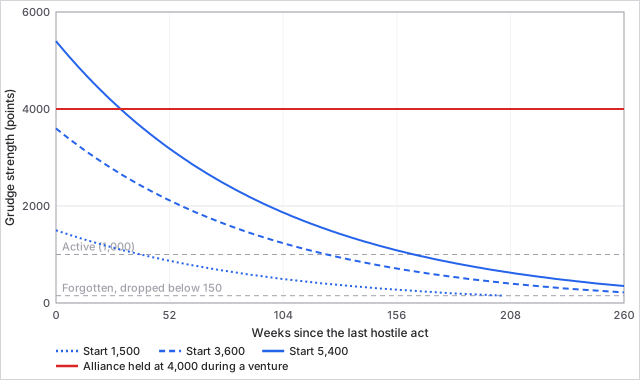
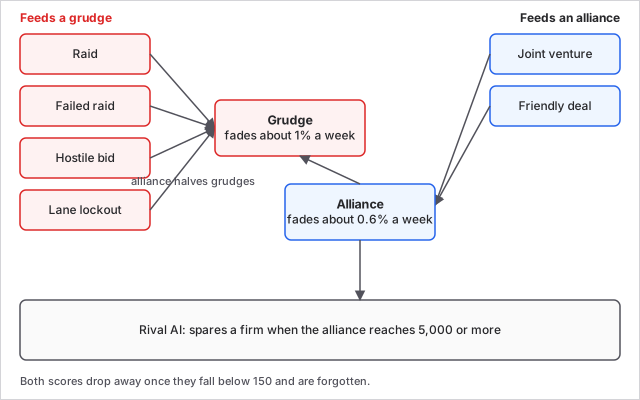
Allies are the other side of the ledger. A joint venture partner starts with an alliance of 5,000 and is held at no less than 4,000 while the venture runs. A friendly deal adds 2,500. An alliance of 1,000 or more shows as an ally, and rivals ask old partners first to share a project. A rival skips raiding or bidding for a firm only while the alliance is 5,000 or more, so the protection is strongest just after a venture is formed or a deal is closed. Friends forgive: forming an alliance halves existing grudges between the two, and a betrayal cools an alliance.
A rival's dossier, on its stock page or a region board, lists its grudges, its friends and its recent moves.
Raids#
A raid is a marketing campaign against a rival's division in a market you both serve, to take some of its plants.
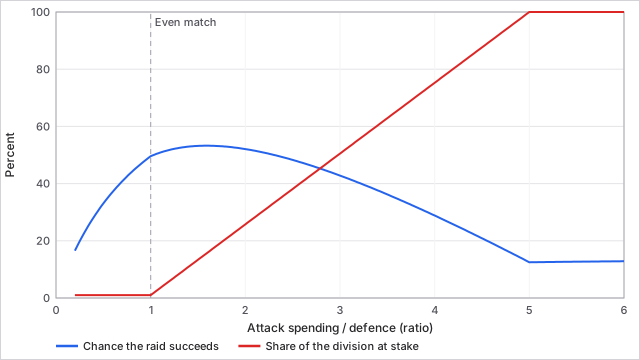
The chance falls past a ratio of about 1.6 because a bigger attack takes a bigger share, and that share drags the odds down.
- You choose the rival's division and a budget.
- Attack strength is your budget plus 13 weeks of your standing marketing. Defence is 13 weeks of the defender's marketing plus 5 percent of its division's quarterly output value.
- The stake at risk is 1 percent of the defender's blocks at even strength, rising to the whole division at five to one.
- The chance of success is attack over attack plus defence, cut by 85 percent of the stake share, and held between 5 and 95 percent.
- The budget buys advertising whether you win or lose. If you win, you take the plants into your own division at your own strategy and pay the defender half their book value.
Every rival row has a Raid button that opens a quote showing the chance, the plants at stake, the price, the rival's defence, any repeat-raid surcharge and a budget slider. Each earlier raid on the same rival still on the record costs 40 percent of the campaign budget in extra legal and retaliation cost, and one raid is forgotten per quarter. New companies and newly opened divisions cannot be raided for their first 26 weeks. A raid also costs the defender reputation (see Your holding company).
Rivals raid you too, with limits: a rival launches at most one raid a year, and leaves a company it raided alone for 26 weeks.
Takeovers#
Rivals with the right temperament bid for companies, including yours, and you can bid for theirs. A bid goes through funding, two weeks of diligence and an offer that stays open four weeks, then review if the deal is large. The buyer needs more than half the votes after the tender, and can squeeze out the rest at 90 percent. Review applies once a deal would give a group too large a share of a market (see Governments and market laws).
Key numbers#
| Item | Value |
|---|---|
| Cast | 12 people, 2 per temperament |
| Chief executive change | 6 losing four-week periods, after at least 52 weeks in post, 25 percent per check |
| Grudge range | 0 to 10,000; active at 1,000; forgotten below 150 |
| Grudge fade | 1 percent plus 1 point a week |
| Alliance fade | 0.6 percent plus 1 point a week; held at 4,000 during a venture |
| Raid protection for a new division | 26 weeks |
| Rival raid limit | One a year; 26 weeks respite for a raided company |
| Repeat-raid surcharge | 40 percent of budget per raid on record |
| Raid success chance | 5 to 95 percent |
| Raid price | Half of the stake's book value |
Worked example. You raid a rival's 40-block division with a $1,000,000 budget. Your marketing runs $20,000 a week, so your attack is $1,000,000 plus 13 times $20,000, $1,260,000. The rival spends $50,000 a week on marketing, and its division makes $5,200,000 of output a quarter, so its defence is $650,000 plus $260,000, $910,000. Attack is 1.38 times defence, so the stake is 10.5 percent, 4 blocks.
The base chance is 58 percent; the stake cuts it by 8.5 percent of itself, leaving 53 percent. If the division's book value is $20,000,000, those 4 blocks are $2,000,000 and you pay $1,000,000. If you win, the rival's grudge is 3,000 plus 4 times 600, 5,400, active for about 160 weeks. If you raided the same rival a quarter ago, add a $400,000 surcharge.
What you can do#
- Raid a rival with the Raid button on its row (region board or stock page). Check the chance and the price first. A larger budget raises both your chance and the stake you take.
- Defend. Keep marketing up, because defence counts 13 weeks of it. Keep new divisions out of rivals' reach for their first 26 weeks. A company that was raided in the last half year is left alone by rival raiders.
- Make allies. Form a joint venture or close deals with a rival you may need later. Allies are asked first for projects.
- Cool a grudge. An alliance halves existing grudges, and grudges fade; avoid lane lockouts on busy lanes unless you mean it.
- Bid for a rival from its stock page, or defend against a bid by holding more than half of your own votes.
- Read the dossier before a move: it shows a rival's temperament, grudges and recent moves.
Tips: a whole-division raid wins only 15 percent as often as the base chance, so raid in slices, and expect a rival you raid to hold the grudge for years.
Connections#
Driven by
- Currencies: raids and bids stay inside one currency, so rivals in another currency are out of reach.
- Your holding company: raids, hostile bids and joint ventures create grudges and alliances.
- Freight: lane reservations create lockout grudges.
- Governments and market laws: merger review limits takeovers.
- The commodity exchange: world price swings drive speculator rivals.
- Scenarios: each scenario's roster of rival firms.
- Regions and labour: rivals compete for the same worker pools and local markets.
Affects
- Your holding company: raids take plants and reputation; bids and activist-style pressure target your companies.
- Freight: rivals build carriers on busy lanes and reserve lane capacity.
- The commodity exchange: rival sellers set local prices and speculators move stock.
- Regions and labour: rivals bid up wages when they hire.
- Governments and market laws: the cast supplies party leaders and the central bank chair.
Status#
Live in every scenario. The roster of rivals depends on the scenario (see Scenarios), and the cast has a home scenario for each person. Aggression depends on difficulty: Easy rivals never attack your markets, Standard rivals include some fighters and Hard rivals all fight. Raids and bids across a currency line are impossible (see Currencies).
Last checked: 2026-10-29, version 1.8.0
Technical detail: every constant, formula and source file is in Exact rules at the end of this page.
Exact rules#
Cast and replacement#
Sources: content/cast.json, crates/cw-data/src/cast.rs, crates/cw-sim/src/economy/cast.rs.
- 12 people with six temperaments (
Integrator,Raider,Financier,Speculator,Builder,Cautious), two each. LOSS_PERIODS = 6,PERIOD_WEEKS = 4(state.rs),MIN_TENURE_WEEKS = 52,TURNOVER_BPS = 2,500,BENCH_WEEKS = 104. Only periods after the current executive started count. The new executive prefers a different temperament.
Grudges and alliances#
Source: crates/cw-sim/src/economy/rivalry.rs.
MAX_SCORE = 10,000,GRUDGE_DECAY_BPS = 100,ALLY_DECAY_BPS = 60,FLOOR = 150,VENTURE_HOLD = 4,000,ACTIVE = 1,000.- Weekly fade:
score - score x decay / 10,000 - 1. Entries belowFLOORare dropped. on_raid: success adds3,000 + 600 x blocks, failure 1,500.on_hostile_bid: 2,500.on_lane_reserved: only when the lane is at least 6,000 basis points full,600 + share / 5per victim, up to 4 victims. Venture formed: alliance 5,000. Deal: alliance 2,500 (buyer and seller firm).- A new grudge adds to the existing one, capped at
MAX_SCORE. Forming an alliance halves grudges between the two sides; a grudge cools an alliance. - Rival AI spares a firm in raids and bids when the alliance is 5,000 or more (
crates/cw-ai/src/lib.rs), and asks partners with alliance 1,000 or more first.
Raids#
Source: crates/cw-sim/src/economy/sectors.rs, crates/cw-sim/src/economy/structure.rs, crates/cw-ai/src/lib.rs.
RAID_STAKE_MIN_BPS = 100,RAID_STAKE_MAX_BPS = 10,000,RAID_STAKE_DRAG_BPS = 8,500,RAID_DEFENCE_FLOOR_BPS = 500,RAID_PRICE_BPS = 5,000,RAID_GRACE_WEEKS = 26.attack = budget + 13 x marketing_budget.defence = max(13 x defender_marketing + 5 percent x 13 x capacity_value, 1).stake_bps = 100 + 9,900 x clamp(attack / defence - 1, 0, 4) / 4.blocks_at_stake = max(1, blocks x stake / 10,000).price = book x at_stake / blocks x 50 percent.chance = attack / (attack + defence) x (10,000 - stake_share x 8,500 / 10,000) / 10,000, clamped to 500 to 9,500 basis points.- Surcharge:
budget x 4,000 x heat / 10,000, where heat is raids on record minus one per 13 weeks since the last (structure.rs,raid_surcharge). - Successful raid reputation cost to the defender: 300 plus a fifth of the stake; failed 100; a repeat raider loses 120 per raid on record.
- Rival AI:
RAID_COOLDOWN_WEEKS = 52between campaigns,RAID_RESPITE_WEEKS = 26for a raided company. The validator accepts a raid from any company, including yours, at any time after the grace period.
Difficulty#
Source: crates/cw-ai/src/lib.rs (fights), crates/cw-data/src/lib.rs. Easy: no rival fights for share. Hard: all do. Standard: archetypes with a cost-leader, consolidator or vulture weighting. Starting capital is $8,000,000, $5,000,000 and $3,000,000 for Easy, Standard and Hard.
Takeovers#
Source: crates/cw-sim/src/economy/deals.rs. Draft, funded, diligence (DILIGENCE_WEEKS = 2), offer open (OFFER_WEEKS = 4), review (REVIEW_WEEKS = 4), settled. The buyer escrows the maximum price plus TRANSACTION_FEE_BPS = 200. Control needs more than half the votes after the tender. Squeeze-out needs SQUEEZE_OUT_BPS = 9,000. A review that finds no feasible divestiture rejects the deal.